Score: 9/10
Since 1963, the annual Taiga drama produced by and for the NHK channel in Japan has showcased the glorious pageant of Japanese history. Each season consists of roughly fifty episodes which air weekly. I have watched eighteen Taiga dramas; for viewers, it is a big investment. Each Taiga (“big river” in Japanese) focuses on one male or female figure from Japanese history. It benefits a taiga drama immensely when the main character’s life is a nonstop epic journey rising up through a dangerous world, through battle after battle, challenge after challenge, surrounded by the most interesting people who lived in their century. Since the NHK makes taiga dramas annually, those elements cannot always come together–some historical figures lived quieter lives. But the two best examples of this that I have ever seen are GUNSHI KANBEI (2014) and SEGODON (2018). The first is perhaps the greatest taiga drama of the Sengoku Jidai (the warring era c. 1550-1615) and the second is perhaps the greatest taiga drama of the Boshin War and Meiji Restoration (1860s).
“Gunshi” means war strategist, as in a samurai raised on the classics like Sun-Tzu’s The Art of War, who understood both battle and politics. Kuroda Kanbei was born into a minor samurai family in Harima province. He was destined to serve Toyotomi Hideyoshi as one of his two great strategists: Hanbei and Kanbei (known collectively as “Ryobei”–the two Beis). Takenaka Hanbei, the older of the two, engineered Hideyoshi’s early successes. Kanbei was able to succeed the more cerebral and circumspect Hanbei. In contrast, Kanbei was, especially regarding his Christian faith, a more passionate and emotional man. At least, that is how history tends to portray them. With Kanbei’s help, Hideyoshi seized power over most of Japan and became Regent for life.
The NHK values its composer’s contribution, which consists of a huge amount of tracks, so much that the composer always features second in the main title credits. Some taiga dramas open with a title sequence full of charging horses and clashing swords. Others have main titles resembling fashion videos where the camera pans across the plaintive eyes of the lead actor incessantly. The musical score by Kanno Yugo is excellent. Unfortunately, the main theme consisting of a minor key waltz is a rather boring and morose slog set to just such a shampoo commercial. Many of Kanno’s other composed tracks would have made better opening title music. The theme chosen seems to emphasize the tragic nature of some of Kanbei’s personal challenges.
The stage sets which are meant to represent many castles, temples, and battlefields across Honshu, Kyushu, and Korea, are somewhat convincing. The set lighting can be harsh. You can see the spit gushing out of actors’ mouths when samurai scream at each other. NHK did not produce taiga dramas in 4K until 2020’s AWAITING KIRIN.
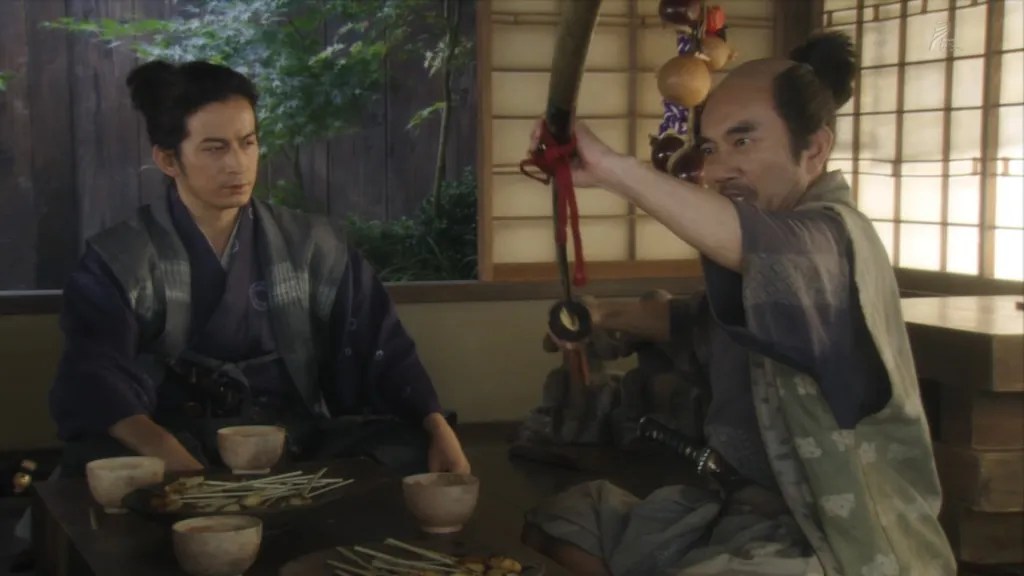
Because taiga dramas stretch across fifty episodes, the main actor has to carry a lot on their shoulders. Often they must portray a character maturing from teenager to deathbed. Depending on who they cast, some pull off the youthful better than the aging, or vice versa. Okada Junichi as Kanbei is capable throughout. Some actors emote so clearly, we always know what they are feeling. Some actors give off cerebral signals so transparently, we can almost hear their thoughts. Okada is a rare example of an actor who does both so well, in every role. It is one of the things responsible for his long and successful career. Another facet of his skills is his excellent swordsmanship and horsemanship. Unlike some recent taigas where the actors have to mount a fake galloping machine and be framed in closeup, most of GUNSHI KANBEI’s stars are trotting along for real. Okada has probably starred in more samurai projects than any other actor in his generation, and the overwhelming number of them are of the highest quality. I have reviewed his film TENCHI: THE SAMURAI ASTRONOMER, one of the greatest of its genre. He was also excellent in HARD DAYS and SAMURAI CHRONICLE.
GUNSHI KANBEI also features the greatest Hideyoshi on film, embodied by Takenaka Naoto (SAMURAI MARATHON). He had starred as Hideyoshi in a previous taiga drama from 1996. That story covered Hideyoshi’s rise and ended at his victory at Yamazaki. The actor agreed to return because GUNSHI KANBEI gave him the chance to play Hideyoshi in his older and more tyrannical years. Surprisingly, Takenaka actually played Hideyoshi five times. I imagine the real Hideyoshi would be fascinated to meet Mr. Takenaka.
Eguchi Yosuke (THE BIG BEE, RUROUNI KENSHIN) gives a sensitive performance as the brutal overlord Nobunaga. It is not as gripping as Shota Sematani’s psychopathic turn in AWAITING KIRIN, but Eguchi stands out as the best of the recent standard takes on Nobunaga. He is particularly compelling in his fascination with the outer world and his wish to explore it. Kuroki Hitomi is brilliant as Lady One, Hideyoshi’s wife. Kanbei’s father is played memorably by the charming Shibata Kyohei (AXE IN THE LABYRINTH). You will love him, you will hate him: Kataoka Tsurutaro turns in a full throttle performance as the clownish, indecisive but crucial lord Kodera whom Kanbei serves as a young man. Kataoka is a veteran of several taiga dramas (TAIHEIKI, MORI MOTONARI, UNBOUND) and always throws himself into his roles fearlessly. With Lord Kodera, lesser actors would have pulled back from the edge. The character of Sen no Rikyu pops up in many dramas from this period. The merchant and famed pioneer of the tea ceremony served as an adviser to the regent and is capably played here with an air of mystery by Ibu Masato.
Kanbei’s three vassals were played by fine young actors who have since gone on to star in projects of their own: Takahashi Issey (NAOTORA, WIFE OF A SPY), Hamada Gaku (MY FAMILY, LAST SAMURAI STANDING), and Hayami Mokomichi (EMERGENCY INTERROGATION ROOM). Ikuta Toma is brilliant as the Christian samurai Takayama Ukon, whose friendship with Kanbei was only one facet of a fascinating life lived in two countries. Ikuta also played the villain in the recent taiga drama, UNBOUND. Okinawan actress Nikaido Fumi plays Lady Yodo, Hideyoshi’s dangerous paramour. Her petulant princess was improved upon when she returned unexpectedly to the role in SHOGUN (2024). James Clavell’s novel, Shogun, changes the names and circumstances of the characters, but the character of Lady Yodo is little altered.
It is incumbent upon all taiga dramas set during the latter Sendoku period to explain the Honno-ji Incident. Spoiler alert for anyone not familiar with Japanese history: Lord Nobunaga is betrayed by his own general, Akechi Mitsuhide. GUNSHI KANBEI does the best job of foreshadowing the infamous betrayal. Not coincidentally, Gunshi Kanbei is the only taiga drama to feature Araki Murashige as an important character. Tanaka Tetsushi stands out for his gripping performance as Araki. Araki is my favorite figure from the Warring Era. Here he is played with riveting intensity by Tanaka Tetsushi (SPEC, GUILTY FLAG). Tanaka captures the intriguing man in three life stages: an optimistic and youthful ronin, a jaded and warn-out daimyo, and a zen monk wrapped in tragedy who renounced the world in favor of the tea ceremony. Here the story suggests that Araki, who was Akechi’s relative by marriage, was a kind of canary in the coal mine facing off against Nobunaga’s brutality and abrasive personality.
In the hands of screenwriter Maekawa Yoichi, GUNSHI KANBEI serves as an excellent introduction to the world of the Sengoku Jidai as well as to the glorious traditions of NHK’s taiga drama.
© July 2026 REEL JAPAN all rights reserved


Leave a Reply