Score: 3/10
The producers of AFTER THE QUAKE took on a tall challenge in adapting novelist Murakami Haruki’s volume of interconnected short stories into a single feature. All such adaptations of short fiction volumes into cinema seem bound to fail. Directed by Inoue Tsuyoshi, AFTER THE QUAKE is adapted from my favorite Murakami book, originally published in Japan as Kami no Kodomo-tachi wa Mina Odoru (All God’s Children Dance).
Each section is realized in the sparest dialogue and shots to keep the narrative moving. The key to understanding the viability of such an adaptation is that the stories are interrelated mostly by emotional content, rather than by plot. The emotional basis of characters’ struggles is trauma and survivor’s guilt following natural disasters. Considering these handicaps, the audaciously grim atmosphere of all the stories doesn’t help. At times I was reminded of old adaptations of the Ray Bradbury fix-up books, The Martian Chronicles and The Illustrated Man. A fix up book is a volume of stories originally unrelated, into which the author has later fermented mycelial networks of dependent origination, in the form of mostly extraneous details.
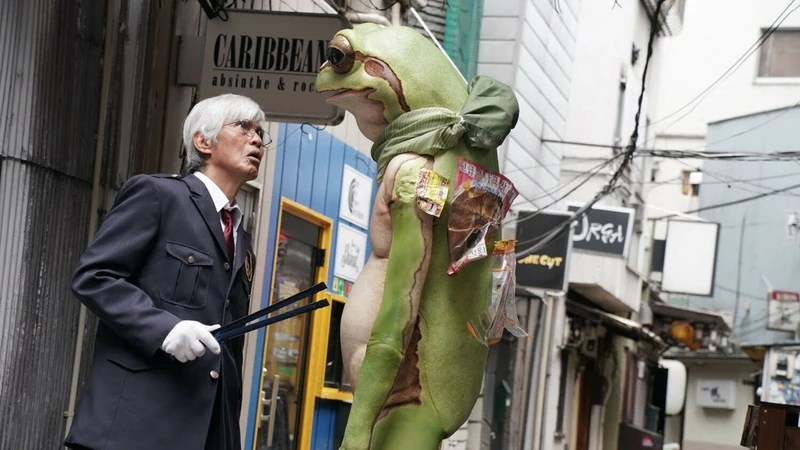
Some of the Murakami stories, especially those weighted around the middle of the film, really never take off the ground. Actors put forward their best dramaturgical foot, but the path disappears. The central conceit of the film, drawn from the story Super-Frog Saves Tokyo, is a subterranean battle between the angry worm and frog-man Kaeru-Kun which epitomizes the tectonic danger and drama. The nature of that underground battle is translated onto the screen in an intriguing (if unsatisfactory) way. Crimson color filtering and footage of (I’m guessing) model trainsets stand in for the worm, intercut with an ominous and equally red hallway from which multiple characters emerge and recede. Inoue and cinematographer Watanabe Yasutaka turn the battle into a kind of Lynchian Hilton hotel reservation. Sadly, the actual frog suit cannot hide behind such glossy techniques and sticks out like a sore thumb.
An extraordinary cast was assembled to make this film, its collective talent largely wasted. Screen veterans Tsutsumi Shinichi (Miyake), Sato Koichi (Katagiri), and Shibukawa Kiyohiko (Tabata), and younger talents like Non (Kaeru Kun), Hashimoto Ai (disappearing wife), Okada Masaki (Komura), and Nishikido Ryo (Kushiro) try their best to anchor the story in human emotions, but there is little for the viewers to cling to but cinematic poetry, and only that of the abstruse postmodern variety. I cannot recommend AFTER THE QUAKE, which proves that the book continues to be unfilmable.
©February 2026 Reel Japan all rights reserved


Leave a Reply