Score: 6/10
An interesting addition to the canon of Japanese horror films and series, HUMAN SPECIMENS is adapted from the novel by Minato Kanae (SUNSET). The production leans on symbolic and transformational cinematography, detailed art design, and strong but enigmatic performances from the stellar cast.
There are many horror productions in which the filmmakers force us to confront unimaginable grotesqueries. This alone cannot sustain a story. In the detective genre, there is the unfolding mystery. In that genre and in thrillers, there is often excitement generated from cat-and-mouse dynamics. Sometimes dark comedy, or even light comedy, balances out the grotesque (for example, both can be found in DEXTER). HUMAN SPECIMENS relies heavily on its unfolding mystery. But it imposes upon the audience the role of detective. Being a study of extremes in the personalities of humans and artists, it reminds me of Thomas Harrris’ Hannibal Lecter novels, populated by eccentrics indulging themselves with free reign amongst their mere-mortal neighbors. However, among the main characters, it is hard to find anyone whose personal agency outweighs the degree to which they are manipulated by others. Our vision as the viewers struggles to secure the truth as the main theme of the story comes into focus. It is vision: its clarity vs. its range.
I recently reviewed SUNSET (2023), another miniseries based on Minato’s work. The two stories do share common features. For instance, both feature a character on death row who is very content to remain there. But whereas SUNSET probes sickening acts of the past, HUMAN SPECIMENS horror unfolds in real time.
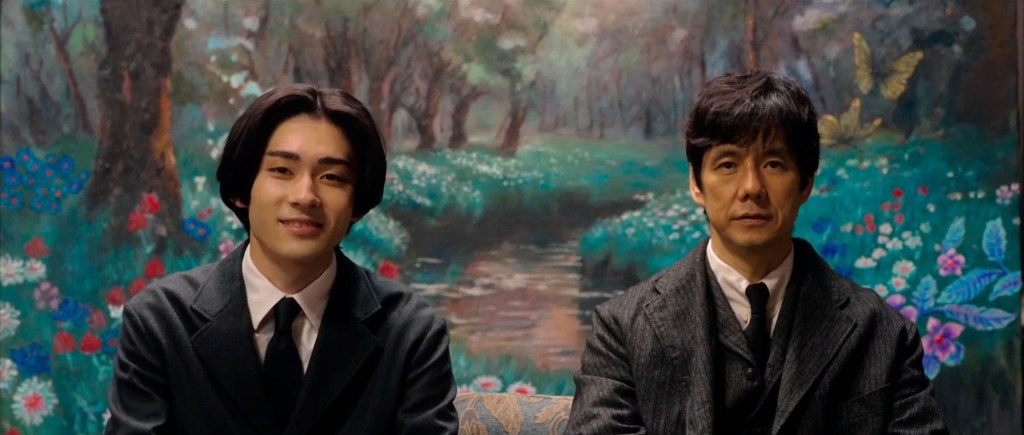
The cast all do yeoman’s work. Nishijima Hidetoshi plays Shiro, an expert on butterflies. At first he seems like a one-dimensional academic. In mysteries and psychological thrillers, the camera tends to peel back layers. It does so here, but it also adds layers. Nishijima succeeds in the role because he is believable from all angles. He was effective in the MOZU films and series, and remarkable in YAE NO SAKURA (2012) as Yae’s brother Kakuma, a historic figure and survivor of the Boshin War. Miyazawa Rie plays Rumi, Shiro’s childhood friend who is now a star in the modern art world and commands adoration through her unique artistic vision. Miyazawa has had a long career in film and music. She was striking in the NHK taiga drama TAIHEIKI (1991). She recently co-starred in ASURA (2025).
Minato’s novel plays with the reliability of the narrator. This is a story that aims to disturb, then pull back the lens and make you rethink things, and keep disturbing. Perhaps the flaw in this narrative is that the story tries to bathe the audience in every kind of pathos from the most exotic and gory to the most familiar and depressing. It is both a story about murder and a multigenerational saga of family dysfunction. There is too much to the story to fit into one film but the filmmakers could have accomplished more with less episodes.
© Reel Japan December 2025 all rights reserved


Leave a Reply