Score: 8/10
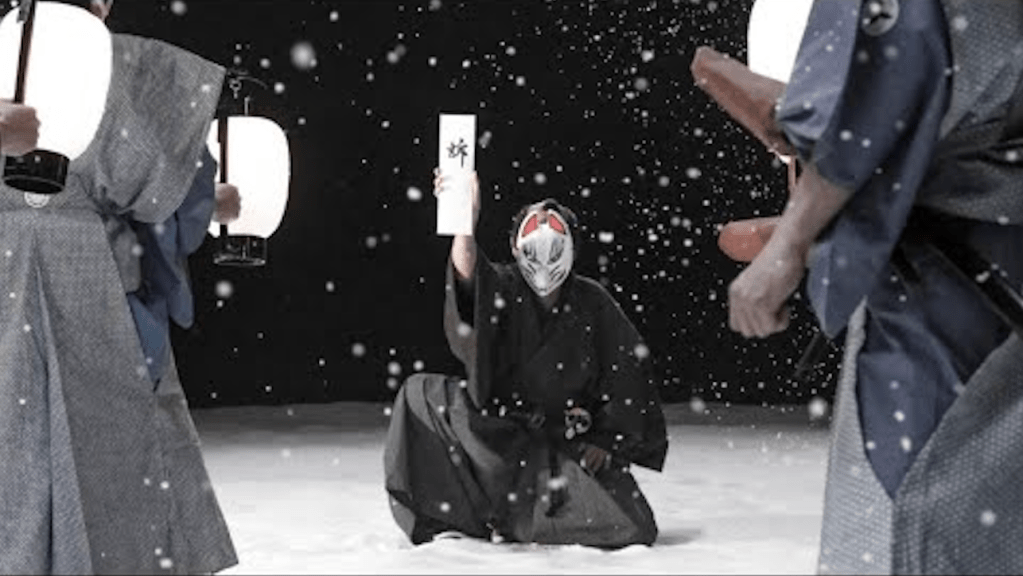
Wakamatsu Setsuro’s SNOW ON THE BLADE concerns the fallout from one of the most dramatic incidents in 19th century Japanese history–the assasination of Lord Ii Naosuke by a gang of revolutionaries. A powerful minister from a family who served the Tokugawa shoguns for generations, Lord Ii angered anti-westerners by agreeing to open ports to American trade and by cracking down brutally on the pro-Imperial factions who wanted power returned from the Tokugawa shoguns to the Imperial court. Lord Ii turns up in many films and television shows and is often depicted as a cultured gentleman whose personal charm and sincere dedication to his job belies the torture and executions his regime pursued. We meet the character of Shimura Kingo (Nakai Kiichi), a rather simple lowly samurai with impressive sword skills who is so taken by Lord Ii’s graceful demeanor that he instantly pledges his loyalty. Employed as senior bodyguard, he will live with shame from his ineffectual role as on that fateful day. Nakai Kiichi was excellent as the Mito lord in SAMURAI ASTRONOMER and the father of Kiyomori in the NHK taiga drama, KIYOMORI. He also starred in the NHK drama SHINGEN in 1988.
The entire Ii-Hikone clan is scandalized by the event. The Shimura family is treated brutally and Kingo enters into a state between life and death where he is judged too guilty to be allowed to die until he tracks down the remaining killers. History throws a major wrench into his mission when, in a few years time, Japan endures a brutal civil war, the shogun abdicates, and the Emperor regains total authority over the nation. Emperor Meiji’s council of ministers (mostly former revolutionaries) did away with the feudal system, banning swords in public, westernizing industry and the military and even discouraging citizens from wearing traditional robes. Kingo becomes a walking anachronism as he obsessively wanders Tokyo with his swords intact. The film skips over the even worse fates which the other failed bodyguards suffered.
Abe Hiroshi plays kingo’s quarry, Sahashi Jubei, in a moving performance. The two characters share the experience of living in limbo and waiting for death each day. For decades, Abe has been one of Japan’s busiest actors known for his many fine lead performances in productions such as IN THE WAKE, the TRICK series, CLOUD UPON THE HILL, and BEFORE WE FORGET EVERYTHING. Nakamura Kichiemon is great as Lord Ii. Hirosue Ryoko (DEPARTURES, NHK taiga drama RYOMADEN) plays Kingo’s suffering wife and channels through her haggard demeanor the frailty contrasting with her youth. Veteran actor Takeshime Masahiro charms as Kingo’s old friend Shinnosoke. There is a great child actor in the role of Jubei’s neighbor.
The film features an unusually subdued score by Hisaishi Joe of Studio Ghibli fame. Nighttime cinematography, something so many films fail at, shines in SNOW ON THE BLADE.
After a strong prologue with clarity of purpose, SNOW yields to chaotic montages while Kingo wanders. There are rather abrupt time shifts so it is hard to tell if we are in Edo Japan or Meiji Japan. Time stamps are inconsistent. Better editing could have fixed this problem.
Revenge films depend on setting up the backstory of the wronged party and SNOW succeeds in grounding that story in the main character. Because of the thorny moral issues and because of the abrupt shift in government and national priorities, the audience will never be certain whose side we are on. Nakai factors this into his performance and it is a key feature of the storytelling that unfolds.
The theme of clinging to the past comes up over and over. There is a great scene when numerous former samurai come together to reinforce their bushido values. The film poses a question about inner values vs outer appearance. Yet Kingo’s quest for honor is a quest for killing. This is not lost on some characters or on the audience. Early on his friend Shinnosuke tells Kingo there is “not a political bone in you.” He is a simple man, but he does have years to ponder the worth of his quest.
(©ReelJapan.com December 2025 all rights reserved)
 REEL JAPAN
Leave a comment